From Vague Memory to Full Inventory: My Rayman Collection Finally Fun and Organized
A friend of mine is going to one of those huge retro gaming fairs next month, the kind with hundreds of tables and a line before the doors even open. He knows I collect Rayman stuff and asked me the obvious question before he left: what am I actually missing?
I didn't have a real answer. What I had was two notes on my phone. One was supposed to list everything I owned, half of it stale because I never went back and updated it after a trade or an auction win and as I have different versions of the same game it was messy. The other was a wishlist that hadn't been touched in over a year, and by that point I genuinely couldn't tell which entries were still missing and which I'd already tracked down. Trying to answer a simple question off two contradictory lists in the Notes app was a bit humbling for someone who's been at this for years.
I'd just picked up a Claude subscription for unrelated reasons and had been meaning to try Claude Code on something real instead of just poking at it. This felt like the excuse. So I described the problem: I collect Rayman games across every platform, edition and region, and I wanted something that could actually track it properly, filters and all, instead of text notes.
I made my prompt and let Claude Code (Opus 5) start working. About fifteen minutes later I had a working dashboard in my browser. Games only at that point, nothing else (to avoid confusing the AI), and it was already a lot to look through: every platform, every region, filterable, with cover art pulled in automatically. I did not expect a first attempt to be that usable, but it was.
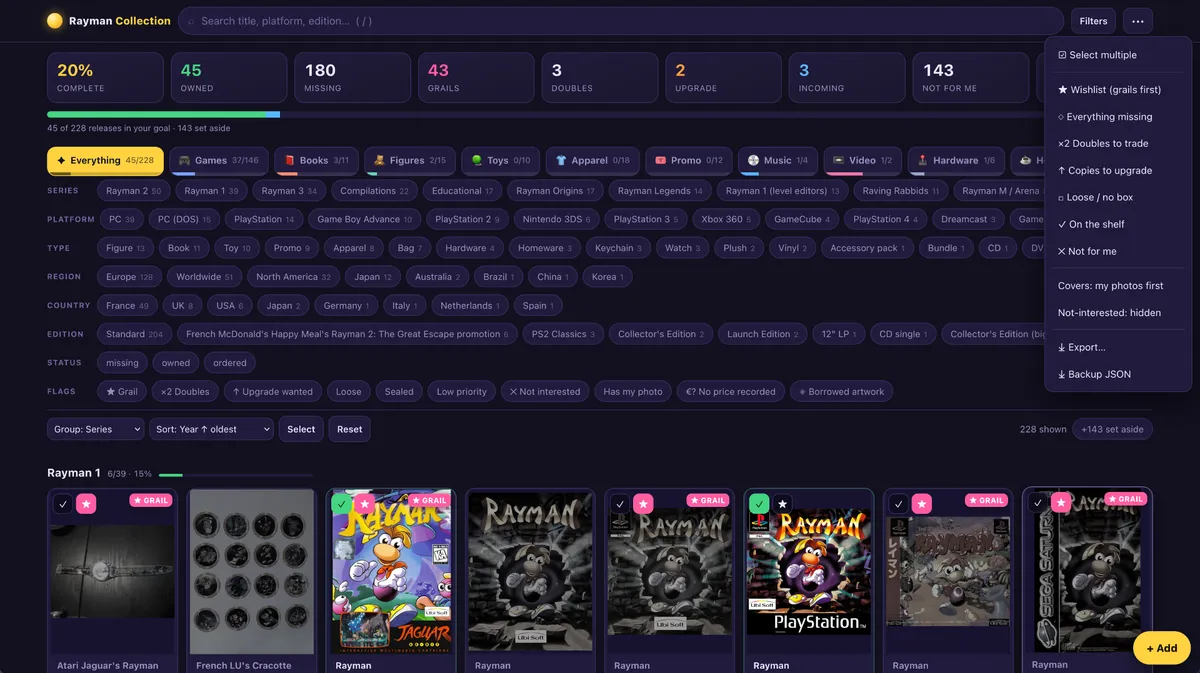
From there it was a handful of small back-and-forths. Group by series instead of just platform. Let me flag a piece as a priority so I know what to actually hunt for first. Mark doubles so I know what I could trade away, letting em upload multiple pictures of my own items, having a "Not interested" filter tag, etc...
Once the games side felt solid I asked for the obvious next step: everything else. McDonald's Happy Meal figures. Vinyls, DVD and VHS. Strategy guides and artbooks. The kind of merch that only makes sense to track if you've been in this hobby a while. That's what turned it from "a Rayman games spreadsheet with a nicer face" into something closer to a real collection tracker, one that treats a keychain with the same seriousness as a boxed copy of Rayman (1995).
What it does now
I'm keeping this part short, a full changelog would bore anyone who isn't me:
- filters by series, platform, region, edition, and now by category too (games, books, figures, apparel, Music...)
- lets you flag something as a priority hunt, mark it as a double you'd trade away, or say "not for me" so it stops cluttering the list
- tracks condition, completeness (loose, boxed, sealed), the price & dates you acquired them and whether you'd want to upgrade the copy you already have
- add your own items that are not in the database.
- room for your own photos per item, so you're not stuck looking at a stock cover instead of the actual thing on your shelf
- an export screen where you build your own file, so I could gave my friend which items are missing!
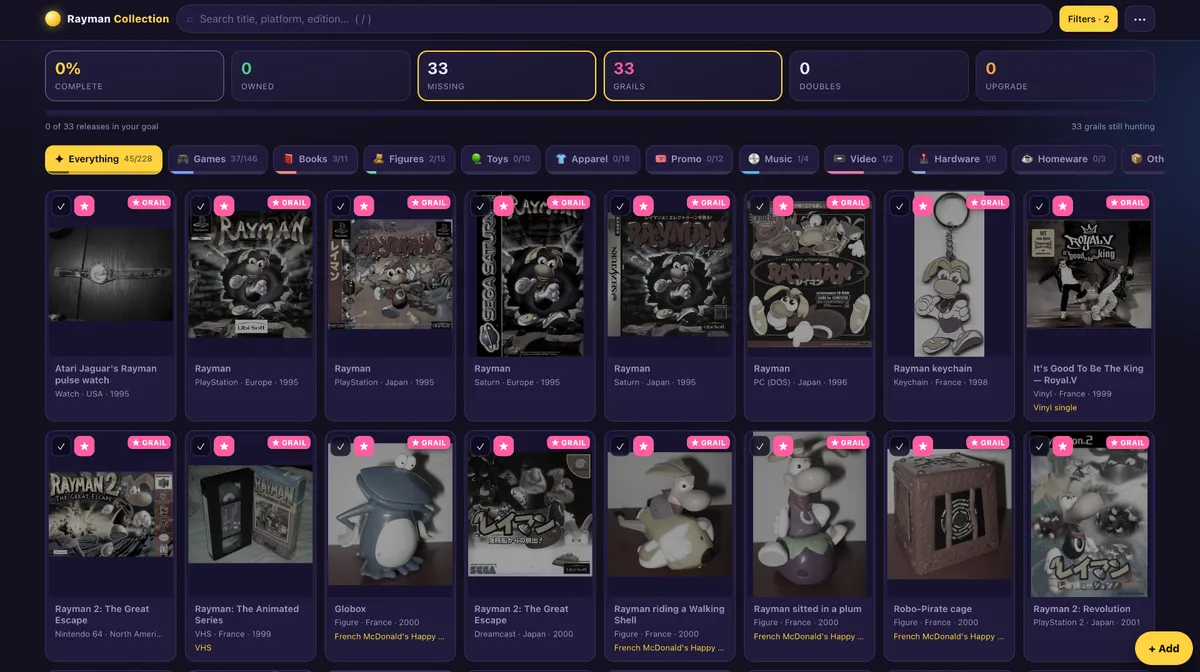
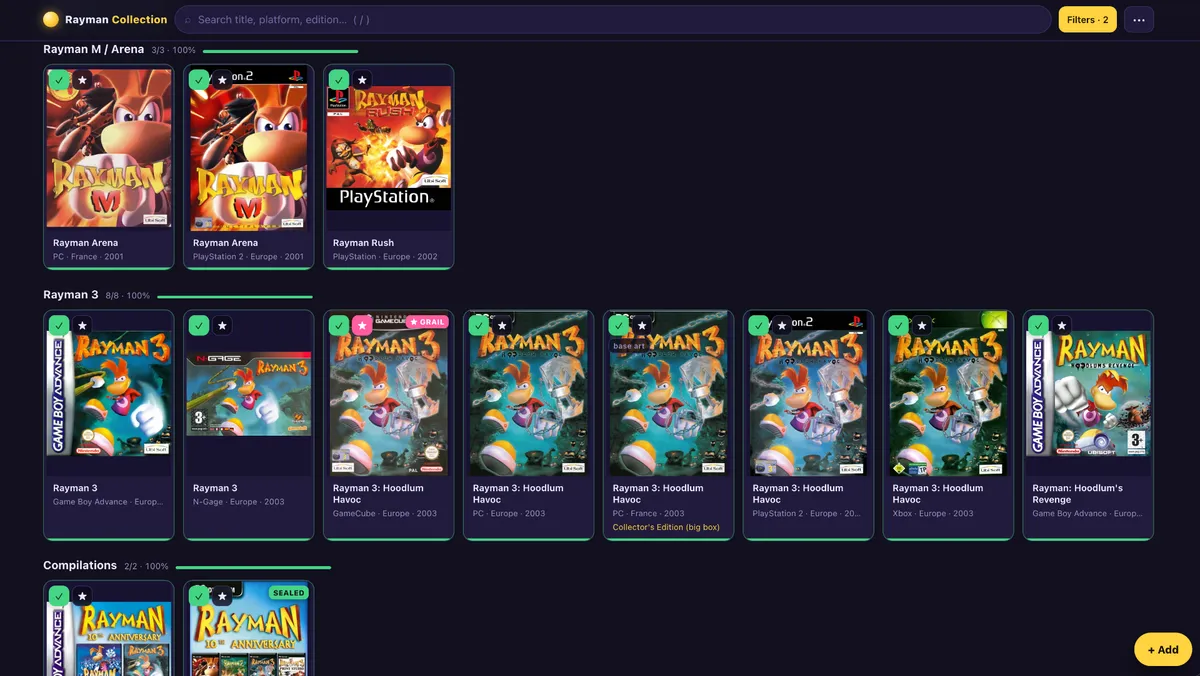
None of this needed a developer. I don't write code, not a line of it. I described what I wanted in plain English and argued a bit with the result until it matched what was in my head. It is not perfect and there is still some roughness around the edges. However it is working well enough for me to use it, and more than just enough. Tracking my collection is now more fun and more precise, I also discovered a few new items I've never heard of that I will definitly try to acquire.
Yes it's 100% AI slop...
Running AI at this scale has a real cost: the electricity, the water used to cool the data centers, the copyright and labor questions nobody's really settled. I'm not going to pretend that's not real, and the hype cycle around all of it is exhausting, frankly.
But there's a separate point worth making. I was ever going to build a dedicated Rayman collection tracker. It's too niche for me to spend hours of my time on software for myself and few dozens of people who care about a Happy Meal figure from 2000. The realistic choice here was never "AI tool or a properly built alternative made by a professional." It was "AI tool or two dying & boring notes on my phone," and I know which one actually got used.
What about your collection?
So now I'm curious, genuinely, how the rest of you keep track of your own collections. A spreadsheet? A notebook? Nothing at all, just memory? I tried the Notion route once for something unrelated and it fell apart after a couple of weeks, so I'm not exactly one to judge but definitely curious.
I'm also weighing open sourcing this at some point, if there's real interest from people outside my own shelf. If that's you let me know and I will try to clean it a bit and make it publicly available for free.